
Unanimous CA Supreme Court reverses death sentence
The California Supreme Court last week unanimously reversed the death sentence for Dora Buenrostro, who was convicted of killing her three children, Susana, Vicente, and

The California Supreme Court last week unanimously reversed the death sentence for Dora Buenrostro, who was convicted of killing her three children, Susana, Vicente, and
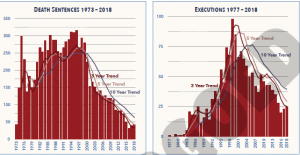
“New death sentences and executions remained near historic lows in 2018 and a twentieth state [Washington] abolished capital punishment, as public opinion polls, election results,

The Texas Department of Criminal Justice obtains its lethal injection drugs “from a pharmacy that regulators have repeatedly cited for dangerous practices,” according to a

“Until I can be sure that everyone sentenced to death in Illinois is truly guilty, until I can be sure with moral certainty that no
In her article, “This Is What Wrongful Conviction Does to a Family,” in Politico, Lara Bazelon looks at the arrest of two men for the 1982
In Texas, three men were executed in the space of four weeks: 43-year-old Alvin Braziel was executed on Tuesday for the 1993 murder of Douglas

Thanks so much to all of you who have signed our petition to California Gov. Jerry Brown asking him to remove as many people as

Representatives from Catholic and other organizations opposed to the death penalty delivered six thousand signatures to California Gov. Jerry Brown yesterday asking him to commute

There was much to celebrate after this week’s election, especially the strides made in criminal justice reform. In Louisiana, Amendment 2 passed easily, which means

After an 18-month hiatus following the U.S. Supreme Court’s Hurst v. Florida decision, Florida is gearing up to begin executions again. Yesterday, the Florida Supreme Court issued an opinion in Hitchcock v. Florida that could affect several other death penalty cases that have been on hold pending the resolution of this one. In a brief decision, the court rejected the plaintiff’s seven arguments that his death sentence was unconstitutional because it

Ohio executed its first inmate in three-and-a-half years late last month, using a new three-drug protocol, including midazolam, rocuronium bromide, and potassium chloride. Forty-five-year-old Ronald Phillips was put to death for the rape and murder of Sheila Marie Evans in 1993. Akron Beacon Journal reporter Jim Mackinnon, who witnessed the execution, reported that Phillips apologized to his victims’ family members, who were present, saying “I’m sorry to each and every

“There is no justification for executing the insane, and no reasoned support for it, as only a glance at the brief of amici—filed by able and fervent citizens spanning the spectrum of political views—will confirm.” So wrote the U.S. Court of Appeals for the Fifth Circuit in its ruling last month that sent the case of Scott Panetti, a mentally ill man who was sentenced to death in 1995 in Texas,
In Texas, TaiChin Preyor was executed late last month, after his appeal was denied by the U.S. Supreme Court. Preyor, who was convicted of the murder of 24-year-old Jami Tackett in 2004 during a drug deal, had appealed his conviction on the grounds that his lawyer had never tried a murder case in Texas before, and relied on Wikipedia for research. This was the fifth execution in Texas this year.

“To spend 20 years in prison for a crime he didn’t commit, and emerge with his humanity and dignity intact … to spend 20 years, day in and day out, fighting for his freedom, it was just so extraordinary. It was totally compelling.”
A petition drive that was started by five men exonerated from Ohio’s death row culminated today with the delivery of 100 thousand signatures to the office of Ohio Gov. John Kasich, asking him to block the execution of Ron Phillips this Wednesday, July 26. Ohioans to Stop Executions delivered the petitions, which were signed by a former prison warden, faith leaders, murder victims’ family members, corrections officials, and citizens. Two
A diverse group of death penalty opponents held a news conference at the state capitol in Ohio on Wednesday to ask Gov. John Kasich to call off the scheduled execution of Ronald Phillips next Wednesday. The Columbus Dispatch reports that a group that included faith leaders, a retired appeals court judge who chaired the state’s task force on the death penalty, corrections officials, and death row exonerees delivered a petition

Scharlette Holdman, who died last week, was renowned in the criminal justice world as one of the foremost death penalty mitigation specialists in the country. “What she saw is that killers are not just born. They have had unbelievably abused and neglectful lives, and that history is relevant,” death penalty lawyer George Kendall told the Marshall Project. Much like Marie Deans, another well-known mitigation specialist (we interviewed her biographer, Todd
“The execution of a man suffering from severe mental illness is an act of particular barbarism — especially if his condition may have been misdiagnosed in trial,” the Washington Post wrote about the William Morva case late last month. But that editorial, as well as one that ran in the LA Post Examiner declaring that, “There are many good, even honorable reasons, for Governor McAuliffe to spare Mr. Morva’s life,” had